<-Back to About Ciphers
Atbash
History
The Atbash cipher is one of the oldest known encryption techniques, with roots in ancient times. Its exact origin is uncertain, but it is believed to have originated in the Middle East, possibly among Hebrew-speaking communities.
The name "Atbash" comes from the first and last letters of the Hebrew alphabet, aleph (?) and tav (?). The cipher operates by substituting each letter of the alphabet with its corresponding letter in the reversed alphabet. For example, 'A' is encrypted as 'Z', 'B' as 'Y', and so on.
The Atbash cipher was used by various ancient civilizations, including Hebrew scribes who employed it in the Hebrew Bible, particularly in the book of Jeremiah. It served as a simple method of encryption and was employed to conceal sensitive or sacred information.
Over time, the Atbash cipher expanded beyond Hebrew usage and became known and used in different cultures. It has been found in ancient Greek and Latin texts as well. However, due to its simplicity, the Atbash cipher does not provide strong security and is easily deciphered using frequency analysis.
While the Atbash cipher played a historical role in the development of encryption techniques, it has largely lost its practical relevance in modern cryptography. Nonetheless, it continues to be studied as an early example of a substitution cipher and serves as an educational tool for understanding basic cryptographic principles.
Some quotes from online:
“Dating far back to ancient Israel, the Atbash Cipher is a simple monoalphabetic substitution cipher used to encrypt the Hebrew alphabet. Supposedly, the Book of Yirmeyahu (Jeremiah) has several words enciphered through the use of Atbash”.
“It was originally used to encode the Hebrew alphabets but it can be modified to encode any alphabet”.
“encryption is also used in the Bible. There are bible parts that are encrypted using a cipher called Atbash that had been invented by Esseness”.
“The name derives from the first, last, second, and second to last Hebrew letters (Aleph–Taw–Bet–Shin). By shifting the correlation one space to the left or the right, one may derive a variant Batgash (named for Bet–Taw–Gimel–Shin) or Ashbar (for Aleph–Shin–Bet–Reish)”.
How it works
Atbash ciphers are fairly simple in how they work, where letters in the plaintext are swapped out with different letters in the cyphertext, the swapping of letters dependent on the order they appear in the alphabet. Taking the 26 letters in the alphabet and putting a line between the middle of them, so that there’s 13 letters on the left and 13 on the right, it looks like this:

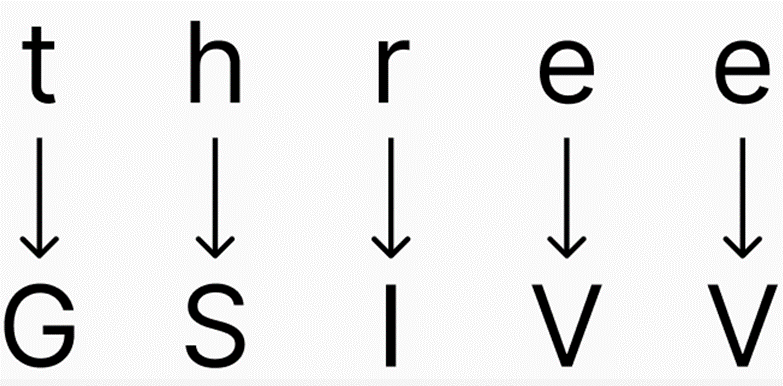
Each letter on one side of the line swaps with a letter on the other side of the line, in the order they appear as they approach the line in the middle. A and Z swap with each other, B and Y, C and X, etc. Using the example plaintext “three”, the resulting cyphertext would be “GSIVV”, as shown below:
A ‘help sheet’ can be used when encrypting (or decrypting) an Atbash cipher:
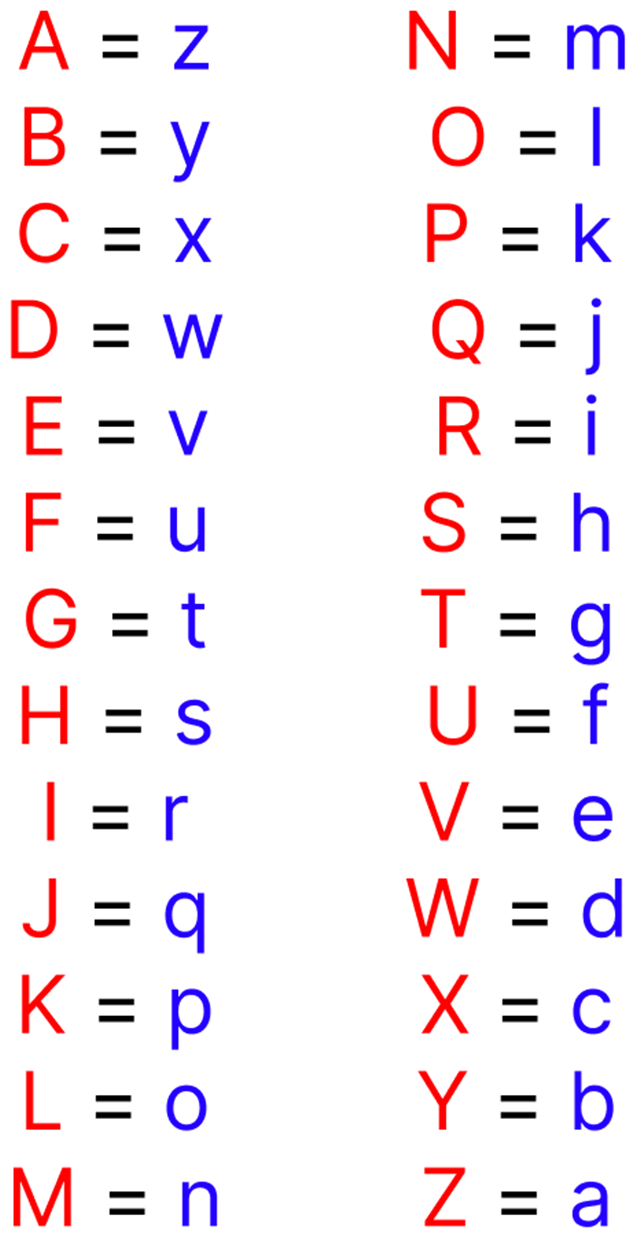
The help sheet makes it clear which letters switch with each other and thus pairs are created between near the start/end of the alphabet and letters near the middle of the alphabet. The colour coding of letters is used to differentiate between cyphertext letters (in red) and plaintext letters (in blue).
Note: the process of swapping letters is the same for encryption and decryption, so as long as users know which letter ‘pairs’ with the other, doing encryption and decryption is straight forward.
How it works (in the game)
In the user vs computer mode, the user is presented a cyphertext and is asked to decipher it, typing their answer into an answer box.
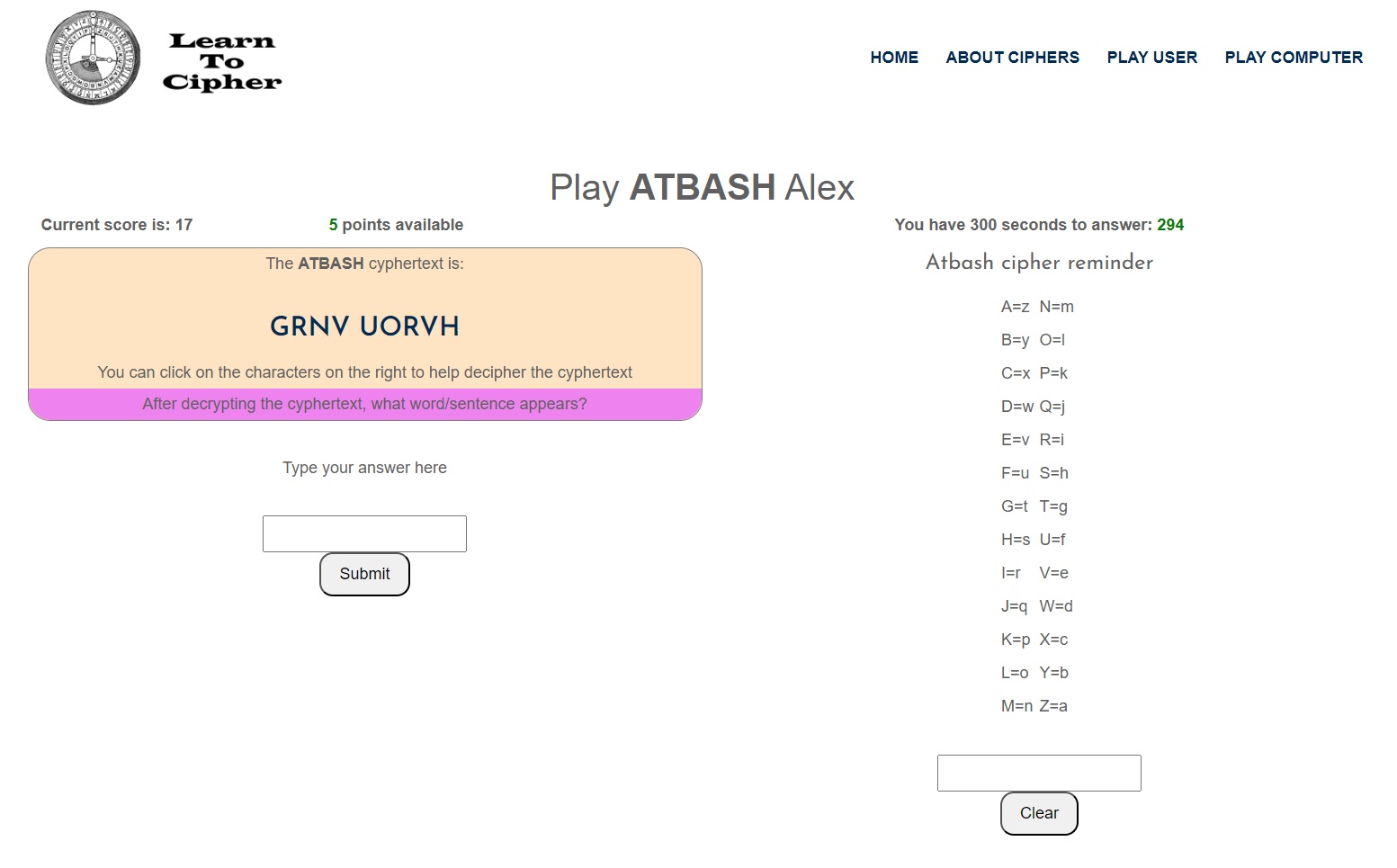
The ‘Atbash cipher reminder’ on the right of the picture is an interactive tool that can be used by clicking on the (capital/uppercase) letters that appear in the cyphertext and thus the plaintext should then be produced. The interactive tool is there for users who would rather work out the plaintext first instead of immediately writing it out in the answer box, it is not mandatory to use.
From the cyphertext “GRNV UORVH”, the plaintext is “time flies”.
<-Back to About Ciphers